Evaluating the Human Anatomy Strong Line Icon for Digital Projects
Selecting the appropriate visual assets for medical, educational, or health-related digital projects requires careful consideration of both aesthetic style and technical utility. The Human Anatomy Strong Line Icon set represents a specific category of vector graphics designed to balance visual clarity with professional authority. Unlike filled or solid icons, strong line art relies on consistent stroke weights to define form, making it particularly suitable for interfaces and informational materials where space is at a premium. For designers, developers, and content creators evaluating this asset, understanding its technical specifications, format versatility, and appropriate use cases is essential for determining whether it aligns with project requirements.
Defining the Asset and Visual Style
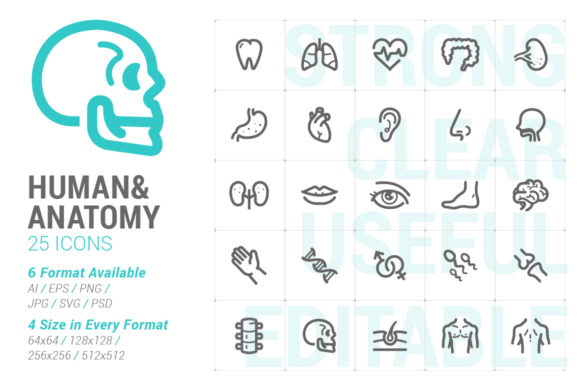
The Human Anatomy Strong Line Icon is a collection of graphical symbols representing various anatomical structures, organs, and biological systems. The defining characteristic of this set is the "strong line" aesthetic, which utilizes bold, uniform strokes rather than gradients, shadows, or complex fills. This stylistic choice serves a functional purpose beyond mere decoration. In user interface design and infographic creation, line icons generally offer higher legibility at smaller sizes compared to detailed illustrations. The negative space within the icon allows background colors or textures to show through, facilitating easier integration into diverse design schemes without creating visual clutter.
When evaluating this specific icon set, it is important to recognize that it targets a middle ground between minimalist thin-line icons and heavy solid glyphs. This makes it versatile for contexts that require a sense of robustness and reliability—attributes often associated with healthcare and scientific communication—while maintaining the modern, clean appearance expected in contemporary web and app design.
Technical Specifications and Format Versatility
A primary factor in selecting digital assets is workflow compatibility. The Human Anatomy Strong Line Icon set distinguishes itself through comprehensive file format support, addressing the needs of various software ecosystems. Understanding these formats helps users assess whether the asset will integrate smoothly into their existing pipeline.
- Vector Source Files (.ai and .eps): The inclusion of Adobe Illustrator (.ai) files containing organized artboards and EPS8 vector files ensures long-term editability. EPS8 compatibility is notable as it maintains broad support across older vector software and non-Adobe platforms. These formats allow designers to modify stroke width, color, and geometry without quality loss.
- Scalable Vector Graphics (.svg): Individual SVG files are provided for each icon in four distinct sizes. This is critical for responsive web development, as SVGs render sharply on high-DPI displays and can be styled via CSS. Having pre-sized SVGs reduces the need for manual optimization during implementation.
- Raster Formats (.png and .jpg): For users who do not work in vector environments, individual PNG and JPG files are included. The PNGs offer transparency for layering, while JPGs provide white-background versions suitable for documents or basic presentations. Both raster formats are generated in 64x64 px, 128x128 px, 256x256 px, and 512x512 px dimensions.
- Photoshop Integration (.psd): The inclusion of Photoshop Shape Layers in four sizes caters specifically to UI designers and digital artists working within the Adobe Photoshop ecosystem. Shape layers remain editable and scalable within PSD files, bridging the gap between pure vector workflows and pixel-based composition.
This multi-format approach reduces friction for teams with mixed toolsets. A marketing team might use the pre-rendered JPGs for a quick slide deck, while the development team utilizes the SVGs for the live website, all sourced from the same cohesive visual language.
Strategic Applications and Use Cases
The utility of the Human Anatomy Strong Line Icon extends across several professional domains. Evaluators should consider how the asset performs in specific contexts relevant to their objectives.
Web Marketing and Social Media Services
In digital marketing for healthcare providers, wellness brands, or pharmaceutical companies, visual consistency builds trust. These icons serve as effective visual anchors in social media carousels, service showcase pages, and ad creatives. The strong line weight ensures visibility on mobile feeds where fine details might be lost, while the anatomical accuracy conveys professionalism.
Educational and Informational Content
For online courses, medical blogs, or patient education portals, clarity is paramount. These icons function well as bullet points, section headers, or diagrammatic elements in infographics. Because they avoid excessive detail, they support cognitive processing by providing recognizable signifiers without overwhelming the reader with photorealistic imagery that may be distracting or unsuitable for general audiences.
User Interface and App Design
Health tracking apps, telemedicine platforms, and fitness applications benefit from standardized iconography. The availability of multiple sizes (64px to 512px) supports various UI components, from navigation bars to feature highlights. The vector nature of the source files allows product designers to adapt the icons to match specific brand guidelines regarding corner radius or stroke termination.
Benefits and Practical Considerations
Adopting this icon set offers several tangible benefits. The primary advantage is time efficiency; acquiring a pre-made, professionally structured set eliminates hours of custom illustration work. The organization of AI artboards and individual file exports streamlines asset management, reducing the likelihood of version control errors. Furthermore, the strong line style provides a neutral yet authoritative tone that adapts well to rebranding efforts through simple color changes.
However, there are tradeoffs to consider. Pre-made icon sets, by definition, lack the bespoke uniqueness of custom illustration. If a project requires highly specific anatomical representations not included in the standard set, users may need to create additional icons to maintain consistency, which requires vector illustration skills. Additionally, while the strong line style is versatile, it may not suit every brand identity. Luxury wellness brands might prefer thinner, more delicate lines, while pediatric-focused applications might require softer, filled, or cartoon-style imagery. Evaluators must honestly assess whether the "strong line" aesthetic aligns with their target audience's expectations and emotional response.
Determining Fit: When to Choose Alternatives
While the Human Anatomy Strong Line Icon is a robust solution for many scenarios, it is not universally applicable. Decision-makers should consider alternatives in the following situations:
- High-Fidelity Medical Training: If the goal is surgical training or detailed anatomical study, simplified icons are insufficient. Detailed vector illustrations or 3D renders would be necessary to convey spatial relationships and tissue texture accurately.
- Emotional or Narrative Storytelling: Icons are symbolic, not narrative. Projects aiming to evoke empathy or tell patient stories may benefit more from custom photography or illustrative scenes rather than functional iconography.
- Strict Brand Alignment: If an organization already has an established icon library with different stroke weights or corner radii, introducing this set could create visual dissonance. In such cases, commissioning custom icons that match existing guidelines is often preferable to adapting a mismatched set.
- Licensing Restrictions: Always verify the specific license terms associated with the asset. Some licenses restrict use in trademarked logos, resale templates, or certain commercial applications. Ensuring compliance is as important as aesthetic fit.
Making an Informed Selection
Ultimately, the decision to utilize the Human Anatomy Strong Line Icon should be driven by a combination of technical requirements and strategic alignment. The comprehensive file format support—from editable AI and EPS vectors to ready-to-use PNG and JPG rasters—makes it a pragmatic choice for teams needing flexibility across print, web, and presentation mediums. The four-size generation system further enhances usability for responsive design workflows.
However, successful implementation depends on matching the asset’s inherent characteristics to the project’s goals. For web marketing agencies, social media managers, and app developers seeking clear, professional, and adaptable anatomical symbolism, this set offers significant value. For projects requiring specialized detail, unique artistic expression, or strict adherence to pre-existing visual systems, alternative solutions may warrant exploration. By weighing these factors objectively, stakeholders can select visual assets that not only meet immediate production needs but also support long-term communication effectiveness.