Evaluating the Stay Safe, Social Distancing Graphic for Professional and Educational Design Projects
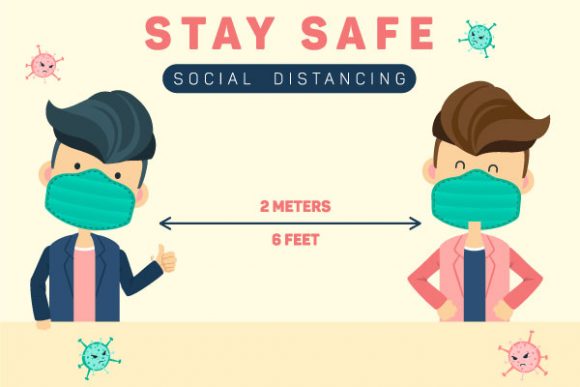
Visual communication plays a critical role in public health messaging, educational environments, and workplace safety protocols. When selecting assets for these sensitive contexts, the technical quality and adaptability of the artwork are just as important as the message itself. The Stay Safe, Social Distancing Graphic represents a specific category of vector-based illustration designed to convey safety guidelines without relying on rasterized imagery that degrades over time or across different media. Understanding the distinct attributes of this resource helps designers, educators, and administrators determine if it aligns with their current project requirements compared to other available visual solutions.
Technical Composition and Layered Architecture
The primary differentiator for high-quality safety illustrations is the separation of design elements. Unlike flattened images where text, characters, and backgrounds are merged into a single pixel grid, the Stay Safe, Social Distancing Graphic is constructed with all elements on separated layers. This architectural choice is significant for professional workflows. It allows users to isolate specific components—such as the "stay safe" typography, the social distancing iconography, or background textures—and modify them independently. For a school administrator creating signage for a hallway, this means the ability to adjust the color palette to match institutional branding without affecting the legibility of the safety icons. For a healthcare provider, it allows for the removal of non-essential decorative elements to maintain a sterile, clinical aesthetic.
This layered approach contrasts sharply with standard stock photography or pre-rendered 3D illustrations often found in general marketplaces. While those alternatives may offer photorealism, they rarely permit structural editing. If a project requires changing the demographic representation of figures or altering the spacing between illustrated characters to reflect updated distance guidelines, a flattened image becomes obsolete. The vector format included in this download ensures that such modifications remain possible throughout the asset's lifecycle.
Vector Scalability Versus Raster Alternatives
Resolution independence is a non-negotiable factor for safety graphics intended for multi-format deployment. The Stay Safe, Social Distancing Graphic is provided as a high-quality vector illustration, specifically in EPS 10 format. This mathematical basis allows the graphic to scale to any size without loss of resolution. A poster printed at 24x36 inches will retain the same crisp edges as a web banner displayed at 300 pixels wide. This versatility eliminates the need to purchase multiple size variations or worry about pixelation when resizing for large-format printing.
When comparing this to raster-based alternatives like PNG or JPG safety signs, the tradeoffs become apparent. Raster files are fixed-resolution; enlarging them introduces artifacts and blurriness that can undermine the authority of a safety message. Conversely, while SVG is another common vector format, EPS 10 maintains broader compatibility with legacy professional software and print-shop workflows. The inclusion of a JPG preview serves only as a reference file, ensuring the user can verify the content before opening the editable source. This distinction matters for organizations that rely on older versions of Adobe Illustrator or CorelDRAW, as newer vector formats sometimes break backward compatibility.
Customization Potential for Diverse Environments
Safety messaging is not one-size-fits-all. The utility of the Stay Safe, Social Distancing Graphic lies in its editability. The package includes one editable EPS file, which serves as the master template. This is particularly relevant when comparing this resource to free online generators or rigid template services. Free tools often limit customization to preset colors and fonts, resulting in generic visuals that fail to resonate with specific audiences. Rigid templates may force a layout that does not fit unique physical spaces, such as narrow corridor markers or vertical elevator signage.
With an editable vector source, the graphic adapts to the environment rather than forcing the environment to adapt to the graphic. Consider a university campus needing to update guidance mid-semester. With this asset, the design team can quickly swap out text or adjust icon density to reflect new policies. In contrast, commissioning a custom illustrator for every policy update is cost-prohibitive, and using static downloads leads to visual inconsistency across campus. The balance here is between the low cost of stock assets and the high flexibility of custom work; this graphic occupies a middle ground that offers professional adaptability at a fraction of bespoke pricing.
Educational and Institutional Suitability
The description notes this resource is perfect for school projects, but its application extends to any structured learning or compliance environment. Educational settings require visuals that are clear, non-threatening, and easily understood by varying age groups. The vector style typically associated with this type of graphic tends toward clean lines and simplified forms, which reduces cognitive load compared to complex photographic scenes. For younger students, abstract representations of distance are often more effective than realistic depictions that might induce anxiety.
However, decision-makers should evaluate whether the specific artistic style matches their institutional tone. While the Stay Safe, Social Distancing Graphic excels in clarity and scalability, some corporate environments may prefer data-driven infographics or minimalist icon sets over illustrative approaches. If the goal is to present statistical compliance data alongside safety reminders, a pure illustration might need to be paired with separate charting tools. The strength of this asset is in behavioral prompting and environmental wayfinding, not necessarily in dense information architecture.
File Format Compatibility and Workflow Integration
Before acquiring any digital asset, verifying technical compatibility is essential. The EPS 10 format included in this instant download is an industry standard, but it assumes access to vector editing software. Users who only possess basic photo editors or word processing programs will find themselves unable to utilize the editable features. In such cases, a pre-sized PNG bundle might be a more practical alternative, despite the loss of scalability. The Stay Safe, Social Distancing Graphic is best suited for users who have either in-house design capabilities or access to a print vendor who can handle vector files.
For those with the appropriate tools, the workflow advantages are substantial. Vector files allow for global color changes via swatch libraries, ensuring consistent brand alignment across dozens of derivative assets. Text remains editable, meaning translations or updates do not require redrawing. Comparatively, purchasing individual JPGs for each language or variation creates file management overhead and increases long-term costs. The single editable source model supports sustainable design practices by reducing digital waste and streamlining production pipelines.
Assessing Value Against Project Scope
Determining whether this specific graphic is the right choice requires an honest assessment of project scope and longevity. For temporary, one-off events where speed is paramount and quality is secondary, free clip art or smartphone-generated signs may suffice. However, for permanent installations, official communications, or materials that represent an organization’s public face, the investment in a high-quality vector illustration pays dividends in perceived professionalism and operational flexibility.
The Stay Safe, Social Distancing Graphic offers a robust solution for users who prioritize control and quality. Its separated layers and scalable format address the most common pain points in safety signage production: inconsistency, pixelation, and inability to update. Yet, it is not a universal panacea. Organizations requiring hyper-realistic imagery, complex 3D rendering, or automated template generation may need to look elsewhere. By weighing the technical benefits of vector editability against the specific demands of their audience and infrastructure, buyers can make informed decisions that support both immediate safety needs and long-term communication strategies.
Making the Final Selection
Ultimately, the decision hinges on the intersection of technical capability and communicative intent. If your team possesses the software to edit EPS files and requires a versatile, scalable asset that can evolve with changing guidelines, this graphic represents a strong candidate. It bridges the gap between generic stock art and expensive custom illustration, providing a professional foundation for safety messaging. Conversely, if your needs are strictly static or your technical resources are limited, exploring pre-rendered alternatives may yield faster results. Evaluating these factors objectively ensures that the chosen visual resource effectively supports the overarching goal of maintaining safe, informed environments.