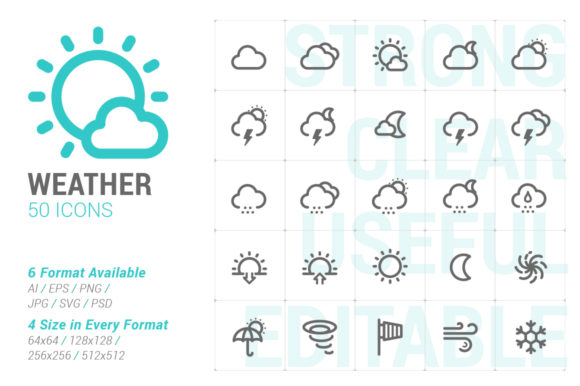
Weather and Forecast Strong Line Icon: Integrating Versatile Visual Assets into Digital Workflows
In the landscape of digital product design and content creation, visual consistency is not merely an aesthetic choice but a functional requirement. The Weather and Forecast Strong Line Icon set serves as a foundational asset library for professionals who need to communicate meteorological data, environmental conditions, or scheduling variables with clarity. Unlike decorative illustrations, these strong line icons are engineered for utility, providing a robust visual language that integrates seamlessly across web marketing agencies, social media showcases, online marketing apps, and website templates. Understanding how to leverage this specific icon set requires looking beyond the imagery itself and examining the technical infrastructure that supports efficient design workflows.
The Role of Multi-Format Assets in Production Pipelines
A critical bottleneck in creative production is often asset compatibility. Designers frequently lose valuable time converting files, tracing raster images, or redrawing symbols because the original source material lacks flexibility. The Weather and Forecast Strong Line Icon collection addresses this friction point by providing a comprehensive suite of file formats including .ai, .eps, .svg, .png, .psd, and .jpg. This variety ensures that the asset can be deployed at any stage of a project without requiring intermediate conversion tools or third-party plugins.
For vector-based workflows, the inclusion of Illustrator AI files containing artboards allows for global editing. If a brand guideline changes regarding stroke weight or corner radius, a designer can update the master artboard and propagate those changes across the entire set. Similarly, EPS8 vector files provide backward compatibility for legacy systems or print vendors who may not support newer SVG standards. This dual-vector approach safeguards the integrity of the design process from initial concept through to final archival.
On the raster side, having individual PNG and JPG files pre-exported eliminates the guesswork of export settings. For web developers and app designers, individual SVG files for each icon ensure that codebases remain clean and modular. Instead of managing a massive sprite sheet that requires complex CSS positioning, teams can import only the specific weather symbols needed for a given view, reducing page load times and simplifying maintenance.
Strategic Sizing for Responsive Implementation
Modern digital interfaces are inherently responsive, meaning assets must perform correctly across a spectrum of viewport sizes. The Weather and Forecast Strong Line Icon set is structured around four distinct size tiers: 64x64 px, 128x128 px, 256x256 px, and 512x512 px. This systematic sizing strategy aligns with standard grid systems and touch target requirements used in UI/UX design.
- 64x64 px: Ideal for dense data tables, mobile navigation bars, and inline text indicators where space is at a premium.
- 128x128 px: Suitable for standard dashboard widgets, list views, and secondary interface elements.
- 256x256 px: Optimized for feature highlights, promotional banners, and tablet-optimized layouts.
- 512x512 px: Designed for high-density displays, presentation slides, infographics, and app store screenshots.
By utilizing pre-sized assets, teams avoid the degradation that occurs when scaling raster images arbitrarily. Photoshop Shape Layers in these specific dimensions allow for non-destructive resizing within the Adobe ecosystem, while individual JPG files on white backgrounds provide ready-to-use assets for non-design stakeholders who need to insert weather graphics into documents or emails without opening professional software.
Application Across Business and Creative Verticals
The utility of this icon set extends far beyond meteorology apps. In broader business contexts, weather icons function as powerful metaphors and functional indicators. Web marketing agencies utilize these strong line visuals to create cohesive case studies and service showcases. A "storm" icon might represent crisis management services, while a "sun" icon could symbolize growth strategies. Because the line weight is consistent and bold, these metaphors maintain legibility even when scaled down for social media thumbnails or favicons.
For online marketing apps and SaaS platforms, these icons serve as essential UI components. Whether indicating server status, delivery estimates, or seasonal promotions, the strong line style offers higher contrast than thin-line alternatives, improving accessibility for users with visual impairments. Presentations and promotional materials benefit equally; the 512x512 px versions provide crisp visuals for large-format displays, ensuring that pitch decks and conference materials look professional and polished.
Educators and content creators also find value in the set’s simplicity. When creating infographics or learning modules about climate science, geography, or planning methodologies, the clean aesthetic prevents cognitive overload. The icons act as signposts, guiding the viewer’s eye through complex information hierarchies without competing with the data itself.
Workflow Integration and Customization
Adopting the Weather and Forecast Strong Line Icon set is not just about downloading files; it is about integrating a standardized visual component into your existing workflow. Preparation is key. Before beginning a project, audit your current design system to determine which format best suits your primary output. If you are building a React application, organize the individual SVG files into a component library immediately. If you are preparing a print brochure, link the AI or EPS files directly to your InDesign layout to maintain vector sharpness.
Customization is designed to be straightforward. The strong line style implies a specific stroke width, but this can be adjusted globally in vector formats to match your brand’s unique identity. However, maintain proportionality; increasing stroke weight too aggressively can cause internal negative space to disappear, rendering the icon illegible at smaller sizes. Test adjustments across all four size tiers before finalizing changes. This quality control step ensures that the icon remains functional whether viewed on a smartwatch or a billboard.
Organization impacts long-term efficiency. Create a centralized asset repository accessible to all team members. Tag files with semantic metadata (e.g., "precipitation," "temperature," "alert") rather than generic filenames like "icon_01." This practice reduces search time and prevents duplicate work. For teams using version control, treat the SVG and source files as code assets, allowing for tracking changes and rollbacks if design iterations go awry.
Maintaining Consistency and Quality Control
Visual consistency builds trust. When using the Weather and Forecast Strong Line Icon set alongside other graphical elements, ensure that the optical weight matches. Mixing these strong line icons with filled glyphs or hand-drawn sketches can create a disjointed user experience. Establish clear guidelines on when and how to use these icons within your style guide. Define padding rules, color usage, and interaction states (hover, active, disabled) to ensure the icons behave predictably within interactive environments.
Efficiency also stems from understanding what not to do. Avoid using raster JPGs for web interfaces whenever possible; reserve them for static documents or email signatures where SVG support is uncertain. Do not scale PNGs up beyond their native resolution; instead, return to the vector source or the next largest size tier. These disciplined habits preserve the professional quality of the final deliverable.
Finally, consider the lifecycle of the asset. As design trends evolve, the strong line style may eventually need refreshing. Because the source files are well-organized and available in editable vector formats, updating the set years down the line is a manageable task rather than a complete rebuild. This longevity makes the Weather and Forecast Strong Line Icon set a sustainable investment for agencies, freelancers, and businesses focused on scalable, high-quality digital communication. By treating these icons as integral system components rather than disposable decorations, professionals can streamline production, enhance user experience, and maintain visual excellence across every touchpoint.