Visualizing Complex Policy: A Guide to Gun Regulation Vector Infographics and Constitutional Design Elements
In an era defined by information overload, the ability to distill complex legislative and constitutional topics into digestible visual formats is more valuable than ever. Few subjects are as multifaceted or as frequently debated as gun regulation in the United States. The intersection of legal statutes, historical context, statistical data, and constitutional rights creates a dense web of information that can be difficult for general audiences to navigate. This is where specialized design assets, specifically the gun regulation vector infographic template, play a critical role in modern communication.
For educators, policy analysts, legal professionals, and content creators, utilizing structured visual aids is not merely an aesthetic choice; it is a functional necessity. By leveraging professional-grade vector graphics that include process timeline charts, workflow layouts with linear icons, and comprehensive data visualization tools, communicators can transform abstract legal concepts into clear, educational narratives. Understanding how to effectively use these templates requires a grasp of both the subject matter and the technical specifications of the design files themselves.
The Purpose and Significance of Visual Legal Communication
When discussing topics rooted in constitutional rights presentation design elements, accuracy and neutrality are paramount. Text-heavy documents often fail to engage readers or may inadvertently introduce bias through selective quoting or dense jargon. Infographics serve as a bridge between raw data and public understanding. They force the creator to organize information logically, ensuring that the relationship between different regulatory steps or historical amendments is represented accurately.
The significance of using a dedicated template lies in its pre-structured logic. Unlike generic infographic makers, a template designed for this specific niche understands the gravity of the content. It provides a framework that respects the seriousness of constitutional law while making it accessible. For example, when explaining the Second Amendment alongside modern state-level restrictions, a well-designed visual aid can show the hierarchy of federal versus state law without resorting to inflammatory imagery. This promotes an educational environment where viewers can focus on the mechanics of regulation rather than emotional triggers.
Bridging the Gap Between Law and Daily Life
Gun regulation is not just a theoretical legal concept; it impacts daily life, business operations, and community safety. Small business owners in the firearms industry must understand compliance workflows. Educators teaching civics need to explain the amendment process to students. Journalists covering new legislation must quickly convey changes to their audience. In each of these scenarios, the gun regulation vector infographic serves as a practical tool for clarity. It translates the "legalese" of bills and court rulings into actionable knowledge, helping stakeholders make informed decisions based on a clear understanding of the current legal landscape.
Mastering Data Visualization: The 4-Step Framework
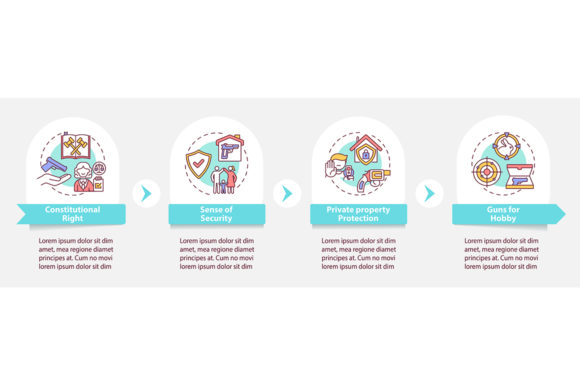
One of the most powerful features included in professional regulatory templates is the data visualization with 4 steps module. Complex policies rarely happen in a vacuum; they are usually the result of a sequential process. Breaking this down into four distinct phases helps prevent cognitive overload for the viewer. Here is how this framework typically applies to regulatory education:
- Legislative Proposal and Drafting: The first step visualizes the origin of a regulation. This might include icons representing committee hearings, bill drafting, or public testimony. It establishes the foundational intent of the law.
- Judicial Review and Constitutional Analysis: The second phase addresses the legal vetting process. Design elements here often reference scales of justice or constitutional text, highlighting how proposed regulations interact with established rights and precedents.
- Implementation and Enforcement: This step moves from theory to practice. Workflow layouts with linear icons are particularly useful here to depict licensing procedures, background check systems, or agency oversight mechanisms.
- Impact Assessment and Feedback: The final step closes the loop by showing how regulations affect society and how data is collected to evaluate efficacy. This reinforces the idea that regulation is a dynamic, ongoing process rather than a static rule.
By adhering to this four-step structure, presenters ensure that their audience receives a complete narrative arc. This method combats common misunderstandings, such as the assumption that laws are implemented instantly or without judicial scrutiny. It builds a broader understanding of the systemic checks and balances inherent in American governance.
Workflow Layouts and Linear Icons: Enhancing Readability
The aesthetic choices in a gun regulation vector infographic template are deliberate. The inclusion of a workflow layout with linear icons is specifically engineered to reduce visual noise. In sensitive political discourse, ornate or aggressive iconography can distract from the facts or imply bias. Linear icons, characterized by clean lines and minimal fill, offer a neutral, professional appearance that directs attention to the accompanying text and data.
These icons act as visual anchors. When a viewer scans a process timeline chart, the consistent style of the linear icons guides the eye from left to right or top to bottom, reinforcing the chronological or logical flow of information. This is essential for beginners who may not yet be familiar with regulatory terminology. The icon serves as a recognizable symbol—a gavel, a document, a shield—that provides immediate context before the user even reads the caption. For experienced readers, this streamlined design allows for faster comprehension of updated data points within a familiar structural framework.
Clarifying Misunderstandings Through Design
A major challenge in discussing gun regulation is the prevalence of misinformation. Visualizations can help correct these assumptions by presenting verified data in a comparative format. For instance, a template might include side-by-side comparisons of federal baseline requirements versus specific state enhancements. By visualizing these differences clearly, the infographic removes ambiguity. It replaces vague assertions with concrete, spatial relationships that are harder to misinterpret. This aligns with E-E-A-T principles (Experience, Expertise, Authoritativeness, and Trustworthiness) by prioritizing factual accuracy and clear sourcing over sensationalism.
Technical Versatility: Understanding File Formats
For designers and communicators, the utility of a template is defined by its flexibility. The standard ZIP file package for these resources typically contains EPS, JPG, PNG, SVG, and AI formats. Understanding when and why to use each format is crucial for maintaining professional quality across different platforms.
- AI (Adobe Illustrator): This is the source file. It is fully editable, allowing users to change colors, adjust text, modify the process timeline chart, or swap out linear icons to match specific branding guidelines. It is essential for deep customization.
- EPS (Encapsulated PostScript): A universal vector format compatible with various design software beyond Adobe. It ensures that the gun regulation vector infographic remains scalable without losing quality, making it ideal for large-format printing like posters or presentation backdrops.
- SVG (Scalable Vector Graphics): The gold standard for web use. SVGs retain crispness at any zoom level and have small file sizes. They are perfect for embedding constitutional rights presentation design elements directly into websites, interactive dashboards, or digital reports.
- PNG (Portable Network Graphics): Supports transparency and is widely compatible. Best for inserting graphics into PowerPoint slides, Word documents, or social media posts where vector editing is not required.
- JPG (Joint Photographic Experts Group): A raster format best suited for photographic backgrounds or quick previews. While less flexible than vectors, it ensures compatibility with virtually every device and platform.
Having access to this full suite of formats ensures that the educational content can be deployed anywhere—from a high-resolution printed policy brief to a responsive mobile website—without compromising visual integrity.
Practical Applications in Modern Education and Business
The relevance of these design assets extends far beyond niche legal circles. In the education sector, teachers utilize these templates to create engaging civics lessons that meet curriculum standards while remaining visually stimulating for digital-native students. In the corporate sector, compliance officers use workflow layouts to train employees on new safety protocols or regulatory changes, reducing liability through better understanding. Non-profit organizations employ data visualization to advocate for policy changes or to educate communities about their rights and responsibilities.
Furthermore, in the realm of digital content creation, bloggers and journalists use these infographics to increase dwell time and improve SEO. Search engines increasingly value helpful, comprehensive content that satisfies user intent. A well-structured article accompanied by a relevant, high-quality infographic signals authority and depth. It transforms a standard blog post into a definitive resource.
Building a Broader Understanding
Ultimately, the goal of using a gun regulation vector infographic template is to foster literacy. By providing the tools to visualize the intricate balance between individual rights and collective safety, we empower individuals to participate more meaningfully in democratic discourse. Whether you are designing a presentation for a university lecture, creating a compliance guide for a business, or writing an informative article for the web, these design elements provide the structure necessary to communicate with clarity, precision, and respect for the complexity of the subject matter.
Investing in high-quality, versatile design resources is an investment in better communication. As the landscape of regulation continues to evolve, having the ability to quickly and accurately update visual representations of the law will remain an indispensable skill for educators, professionals, and creators alike. By mastering these tools, we contribute to a more informed and engaged society.