Visualizing Virtual Assistant Requirements: A Strategic Framework for Modern Delegation
The transition from solopreneurship to scalable business leadership often hinges on a single, critical pivot point: the successful integration of a Virtual Assistant (VA). However, the failure rate in this transition remains surprisingly high, not due to a lack of talent in the marketplace, but due to a lack of clarity in communication. Defining Virtual Assistant Requirements is no longer just about drafting a job description; it has evolved into a sophisticated exercise in workflow architecture and visual communication. As remote work matures, professionals are discovering that text-based instructions are insufficient for conveying complex operational needs. This shift has given rise to a new standard in onboarding and management, where visual assets and structured data visualization play as significant a role as verbal agreements.
In an era defined by digital nomadism and distributed teams, the ability to articulate needs visually is a competitive advantage. Entrepreneurs, marketers, and creators are increasingly turning to specialized design resources, such as a Virtual assistant requirements vector infographic template, to bridge the gap between abstract expectations and tangible deliverables. This article explores why visualizing VA requirements is becoming an industry best practice and how leveraging specific design elements can transform delegation from a source of friction into a driver of growth.
The Evolution of Delegation in a Visual-First Economy
To understand why Virtual Assistant Requirements demand a new approach, we must first look at the broader trends reshaping the freelance and gig economies. The modern workforce is global, asynchronous, and culturally diverse. While this offers immense flexibility, it also introduces semantic noise. A written paragraph describing "social media management" can be interpreted in dozens of ways depending on the reader's cultural context and previous experience. This ambiguity is the enemy of efficiency.
We are currently witnessing a convergence of business operations and user experience (UX) design principles. Just as consumers expect intuitive interfaces, VAs expect intuitive workflows. The market is moving away from vague role definitions toward precise, component-based task architectures. Professionals are paying attention to this shift because the cost of misalignment has increased. In a fast-paced digital environment, spending three weeks correcting course after a poor hire is a luxury few can afford. Consequently, the definition of VA requirements has expanded to include technical specifications, software proficiency matrices, and visual workflow maps that leave little room for misinterpretation.
This trend aligns with the broader consumer preference for bite-sized, digestible information. We process visuals 60,000 times faster than text. When business owners utilize VA equipment presentation design elements or process charts, they are essentially applying cognitive science to human resources. They are reducing the cognitive load required to understand a role, thereby accelerating the time-to-proficiency for new hires and ensuring that both parties share a unified vision of success.
Defining Requirements Through Structured Data Visualization
Clarity is the currency of effective delegation. One of the most practical applications of this philosophy is the use of data visualization with 5 steps to outline core responsibilities. Rather than presenting a VA with a daunting ten-page manual, forward-thinking entrepreneurs break down complex roles into five distinct, manageable pillars. This constraint forces the business owner to prioritize what truly matters and provides the VA with a clear mental model of their daily objectives.
For example, a content marketing VA’s requirements might be visualized through these five data points:
- Content Sourcing: Identifying trending topics within specific niche parameters using designated research tools.
- Draft Creation: Producing initial outlines and copy based on brand voice guidelines and SEO checklists.
- Visual Asset Coordination: Briefing designers or selecting stock imagery that aligns with the editorial calendar.
- Publishing & Optimization: Uploading content to CMS platforms with correct metadata, tags, and internal linking structures.
- Performance Reporting: Compiling weekly analytics dashboards to track engagement metrics against KPIs.
By visualizing these steps, the requirement shifts from a generic "manage blog" instruction to a concrete operational loop. This method also serves as a diagnostic tool. If a VA consistently struggles with step three, the business owner can immediately identify whether the issue is a skill gap, a tool access issue, or a flaw in the workflow design itself. This level of granularity transforms Virtual Assistant Requirements from a static document into a dynamic performance framework.
The Role of Process Timeline Charts in Asynchronous Workflows
Time is the most difficult variable to manage in remote relationships. Without shared physical space, the temporal rhythm of work can easily desynchronize. This is where the process timeline chart becomes an indispensable asset. Unlike a simple to-do list, a timeline chart visualizes dependencies, deadlines, and handoff points. It answers the critical questions of "when" and "in what order" without requiring constant check-in meetings.
Consider the launch of a new product. A linear timeline visualization can map out the VA’s involvement relative to other team members. It might show that keyword research must be completed by Day 1 to allow for copywriting on Day 3, which in turn enables graphic design on Day 5. When these dependencies are laid out visually, the VA understands not just their task, but their impact on the larger ecosystem. This fosters a sense of ownership and accountability that isolated task lists rarely achieve.
Furthermore, timeline charts help in setting realistic expectations during the hiring phase. When candidates review a visual representation of the workload distribution over a week or month, they can self-assess their capacity more accurately than they could with a bulleted list of duties. This leads to better hiring decisions and lower turnover rates, as the Virtual Assistant Requirements are transparently communicated before the contract is even signed.
Standardization via Workflow Layouts and Linear Icons
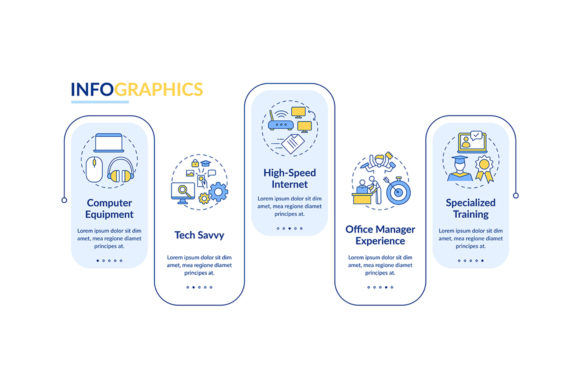
Aesthetics in business documentation are not merely decorative; they are functional. The use of a workflow layout with linear icons serves a dual purpose: it enhances readability and creates a standardized language for operations. Linear icons, with their clean and minimalist aesthetic, reduce visual clutter and focus attention on the action rather than the decoration. In a multilingual team, icons act as universal signifiers that transcend language barriers.
When creating Standard Operating Procedures (SOPs), consistency is key. Using a cohesive set of design elements ensures that every document feels like part of a unified system. If a gear icon represents "system configuration" in one guide, it should represent the same concept in all others. This semantic consistency reduces the learning curve for VAs who need to navigate multiple processes. It signals professionalism and organizational maturity, which in turn attracts higher-caliber talent. Top-tier VAs prefer working with clients who have invested in organized systems because it makes their jobs easier and more predictable.
Moreover, these visual layouts facilitate easier updates. Business processes are fluid; tools change, strategies pivot, and markets evolve. Updating a text-heavy document is tedious and error-prone. Modifying a modular vector infographic or swapping an icon in a workflow layout is significantly faster. This agility allows businesses to keep their Virtual Assistant Requirements current without administrative burnout, ensuring that delegation strategies remain aligned with real-time business needs.
Leveraging Versatile File Formats for Operational Agility
The practical implementation of these visual strategies depends heavily on the accessibility of the underlying assets. This is why professional templates often come packaged in comprehensive formats. A robust resource library should include a ZIP file contains EPS, JPG, PNG, SVG, AI options to cover every conceivable use case across the business lifecycle.
Understanding when to use each format is part of operational literacy:
- AI and EPS Files: These are the source files for Adobe Illustrator. They are essential for making deep edits, changing color schemes to match brand identity, or resizing graphics for large-format printing without quality loss. They represent the master copy of your operational visuals.
- SVG Files: Scalable Vector Graphics are crucial for web-based SOPs, Notion dashboards, and digital handbooks. They remain crisp on any screen size and can be animated or styled with CSS, making them perfect for interactive internal wikis.
- PNG Files: With support for transparent backgrounds, PNGs are ideal for embedding workflow diagrams into slide decks, email signatures, or overlaying onto video training content. They offer high fidelity for digital presentations.
- JPG Files: Best for quick sharing via messaging apps like Slack or WhatsApp, and for printing physical reference sheets. Their universal compatibility ensures that anyone can view the requirements regardless of their device or software.
Having access to this full spectrum of formats ensures that Virtual Assistant Requirements are not locked in a single medium. They can flow seamlessly from a formal contract (PDF/EPS) to a daily dashboard (SVG) to a quick mobile reminder (JPG). This omnipresence reinforces the standards and keeps the workflow top-of-mind.
Future-Proofing Your Delegation Strategy
As we look toward the future of work, the distinction between "managing people" and "designing systems" will continue to blur. Artificial intelligence and automation are handling more transactional tasks, pushing human VAs toward higher-level creative and strategic functions. In this landscape, the ability to clearly define and visualize human-centric requirements becomes even more valuable. AI can generate code or copy, but it cannot yet replicate the nuanced understanding of a well-designed visual workflow that aligns human effort with business intent.
Professionals who adopt these visual methodologies today are building infrastructure for tomorrow. They are creating reusable assets that scale with their business. They are fostering a culture of clarity that reduces friction and enhances creativity. By treating Virtual Assistant Requirements as a design challenge rather than an administrative chore, entrepreneurs unlock a new level of operational excellence.
Ultimately, the goal is to create a partnership where the VA feels empowered, equipped, and aligned. Utilizing vector infographic templates, process timelines, and standardized icons is not about micromanagement; it is about respect. It demonstrates a commitment to clear communication and professional development. In a world where attention is scarce and talent is global, those who can visualize their needs most effectively will be the ones who build the most resilient and successful remote teams. The investment in these design elements pays dividends in saved time, reduced errors, and the peace of mind that comes from knowing your business engine is running exactly as designed.