Educational Games for Children: Design & Strategy
When we discuss educational games for children, we are often talking about two distinct but interconnected concepts: the pedagogical methodology of play-based learning and the visual assets used to communicate that methodology effectively. For educators and parents, the focus is on cognitive development and engagement. However, for designers, marketers, and content creators, the term also encompasses the professional tools needed to present these concepts clearly. A high-quality educational games for children vector infographic template serves as a bridge between complex curriculum data and accessible visual storytelling, allowing stakeholders to map out learning processes with precision and aesthetic appeal.
Diverse Perspectives on Play-Based Learning Assets
The value of structured educational game design varies significantly depending on your role. A freelance graphic designer might prioritize the technical versatility of a template, ensuring it can be adapted for multiple clients without starting from scratch. Conversely, an early childhood educator needs a visualization tool that accurately reflects developmental milestones rather than just looking attractive. Understanding these differing priorities helps in selecting or creating resources that actually serve their intended purpose.
For entrepreneurs and small business owners in the ed-tech space, time is often the most scarce resource. Developing custom illustrations for every pitch deck or curriculum guide is cost-prohibitive. Here, pre-designed childcare presentation design elements offer a practical solution. They provide immediate professional credibility while freeing up budget for actual game development or teacher training. The priority shifts from pure creativity to efficiency and commercial viability. These users need assets that are not only visually pleasing but also legally cleared for commercial use and easily editable to match brand guidelines.
Educators and academic professionals approach these resources with a focus on accuracy and inclusivity. When using a process timeline chart to explain a five-step learning module, the visual hierarchy must support the educational narrative, not distract from it. For this audience, the quality of the iconography matters immensely. Linear icons that depict diverse children and inclusive activities are preferred over generic clip art. Their evaluation criteria center on whether the visual aid enhances comprehension for parents and administrators during presentations or grant proposals.
Evaluating Technical Specifications and Formats
Whether you are a beginner hobbyist creating a blog post or a professional publisher laying out a textbook, file format compatibility dictates workflow efficiency. A comprehensive ZIP file containing EPS, JPG, PNG, SVG, and AI formats ensures longevity and flexibility across different platforms.
- AI and EPS: Essential for professionals who need to scale graphics infinitely for large-format printing or modify individual vector paths. These formats preserve layers and editability within Adobe Illustrator or compatible software.
- SVG: The standard for web developers and digital marketers. Scalable Vector Graphics ensure that educational games for children visuals remain crisp on mobile devices and retina displays without increasing page load times.
- PNG: Ideal for non-designers, bloggers, and office workers who need transparent backgrounds for PowerPoint slides or social media posts but lack vector editing software.
- JPG: Best for quick previews, email newsletters, or contexts where file size is strictly limited and transparency is unnecessary.
Beginners should pay special attention to the inclusion of raster formats like PNG and JPG. While learning vector software is a valuable skill, having ready-to-use images allows new creators to produce professional-looking content immediately while they develop their technical proficiency. Experienced users, meanwhile, will scrutinize the layer organization within the AI or EPS files. Well-organized layers with clear naming conventions save hours of frustration when adapting a workflow layout for a specific project.
Visualizing Data Through Five-Step Processes
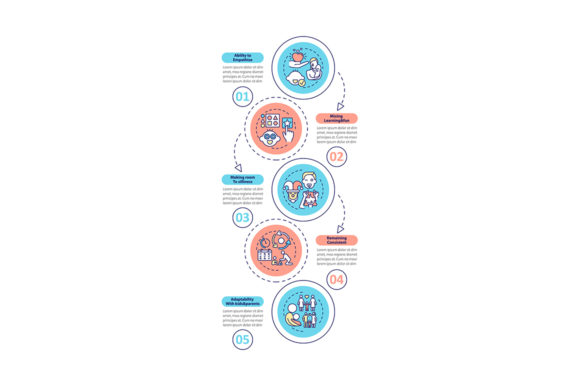
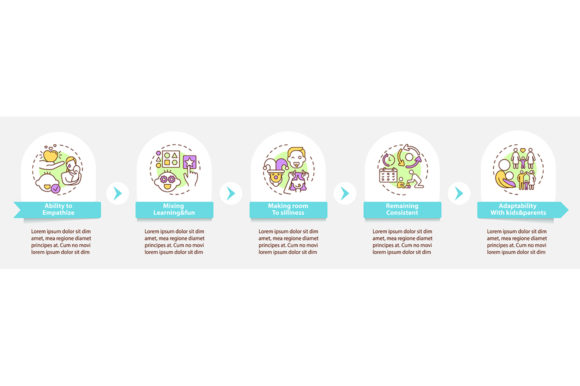
One of the most effective ways to communicate the structure of educational games for children is through data visualization. Complex learning theories often fail to resonate with parents or investors when presented as dense text. A 5-step process timeline chart transforms abstract pedagogy into a digestible narrative flow. This is particularly relevant when explaining gamification mechanics, such as the progression from introduction to mastery.
Consider a scenario where a curriculum developer needs to explain how a math game builds numeracy skills. Using a linear icon workflow, they can visually map the journey: (1) Concept Introduction, (2) Guided Practice, (3) Independent Challenge, (4) Feedback Loop, and (5) Real-world Application. This visualization does more than decorate a slide; it validates the educational rigor of the product. For marketers, this same chart demonstrates value proposition and user retention strategy. For teachers, it provides a clear roadmap for lesson planning and assessment integration.
The choice of linear icons in these templates is deliberate. Unlike skeuomorphic or overly detailed illustrations, linear designs reduce cognitive load. They allow the viewer to focus on the relationship between steps rather than the artwork itself. This minimalist approach is especially important in childcare presentation design elements, where clarity and warmth must coexist. The clean lines suggest modernity and professionalism, while the subject matter retains the necessary approachability for a child-centric topic.
Matching Resources to Project Goals
Identifying whether a specific educational games for children vector infographic template aligns with your needs requires honest self-assessment regarding your end goal. If you are producing a one-off internal memo, a simple PNG might suffice, and investing in premium vector packs may be unnecessary. However, if you are building a long-term brand identity for a preschool or an app, the flexibility of editable vectors becomes a critical investment.
Content creators and bloggers should evaluate the "remixability" of the asset. Can the colors be changed to fit seasonal themes? Can the icons be swapped to represent different subjects like science or literacy? Flexibility extends beyond mere aesthetics; it determines the long-term usefulness of the purchase. A template that only works for one specific type of game has limited ROI compared to a modular system that can adapt to various educational contexts.
Reliability and consistency are paramount for publishers and agencies. When creating a series of workbooks or a multi-page website, visual coherence builds trust. Using a unified set of childcare presentation design elements ensures that page 10 feels like it belongs to the same family as page 100. This consistency reinforces brand recognition and helps children and parents navigate materials intuitively. In contrast, mixing disparate visual styles can signal a lack of professionalism or quality control.
Practical Applications Across Skill Levels
The beauty of modern design resources lies in their accessibility to varying skill levels. A marketing manager with no formal design training can utilize the pre-arranged workflow layouts to create compelling stakeholder reports by simply replacing text and adjusting colors. This democratization of design allows subject matter experts to communicate their ideas effectively without waiting for external design teams.
Conversely, professional illustrators and designers use these templates as foundational scaffolding. Rather than drawing basic timelines or generic child figures from scratch, they leverage existing assets to speed up production, focusing their creative energy on unique customizations that add specific value to the client’s project. For them, the template is a productivity multiplier, not a replacement for creativity.
Hobbyists and parents engaged in homeschooling also find immense value in these resources. Creating custom learning materials at home can be daunting. Access to professional-grade data visualization tools empowers parents to create structured, visually engaging lesson plans that rival classroom materials. It transforms the intimidating task of curriculum design into an accessible, creative activity. By lowering the barrier to entry for high-quality visual communication, these resources support the broader ecosystem of childhood education, ensuring that good design supports good learning regardless of the creator's professional background.
Ultimately, the intersection of educational theory and visual design is where meaningful communication happens. Whether you are analyzing the efficacy of a new learning app, pitching a daycare center expansion, or teaching a concept to a young learner, the right visual framework makes the difference between confusion and clarity. Evaluating these tools based on your specific constraints—be they budget, time, skill, or medium—ensures that your investment in educational games for children assets yields tangible results in understanding and engagement.