Educational Games for Little Kids: Designing Effective Learning Experiences and Visual Resources
Integrating play into early childhood development is one of the most effective strategies for fostering cognitive, social, and emotional growth. Educational games for little kids serve as the bridge between natural curiosity and structured learning, transforming abstract concepts into tangible experiences. For educators, childcare providers, and parents, understanding how to select, implement, and visually communicate these activities is essential. Whether you are designing a curriculum or creating a presentation for stakeholders, having the right framework and visual tools can significantly enhance the impact of your educational initiatives.
Understanding the Role of Play-Based Learning
Educational games for little kids are more than just entertainment; they are carefully designed interactions that target specific developmental milestones. At this stage, children learn best through sensory engagement, repetition, and immediate feedback. These games encompass a wide range of activities, from tactile sorting tasks and memory matching to digital apps that teach phonics and basic numeracy. The primary goal is to create a safe environment where trial and error is encouraged, allowing children to build resilience and problem-solving skills without the pressure of formal testing.
However, the challenge often lies in alignment. Adults frequently struggle to match game mechanics with actual learning outcomes. A game might be engaging but lack educational substance, or it might be academically rigorous but fail to hold a child's attention. Successful implementation requires a deep understanding of age-appropriate capabilities and the ability to articulate why a specific activity matters. This is where professional design resources become invaluable, helping adults organize their thoughts and present their methodologies clearly to other adults, such as parents, administrators, or funding bodies.
Addressing Common Challenges in Early Education
Childcare professionals and educators face several distinct hurdles when incorporating educational games for little kids into their daily routines. One major issue is communication. Explaining the pedagogical value of play to parents who prioritize traditional academic metrics can be difficult. Without clear visualization, the connection between a block-building activity and spatial reasoning development may seem tenuous to an untrained observer. Additionally, curriculum planning often lacks structure, leading to disjointed lessons that do not build upon one another progressively.
Another significant challenge is resource management. Creating custom materials from scratch is time-consuming. Educators need accessible, high-quality templates that allow them to focus on content rather than graphic design. When presenting a new program or explaining a workflow, using generic clip art can undermine professionalism. Instead, utilizing specialized assets like an educational games for little kids vector infographic template ensures that the visual language matches the subject matter. These templates provide a cohesive aesthetic that reinforces the theme of early childhood development while maintaining a polished, professional appearance suitable for formal presentations.
Visualizing the Process: A 5-Step Framework
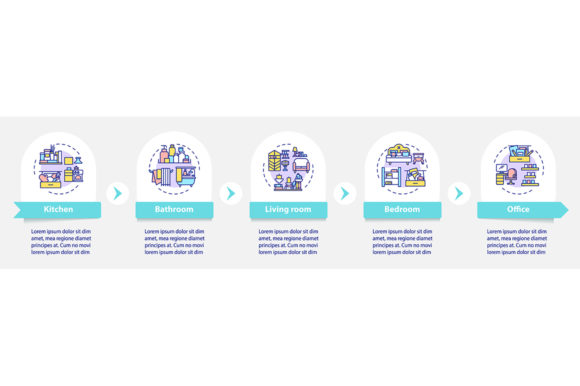
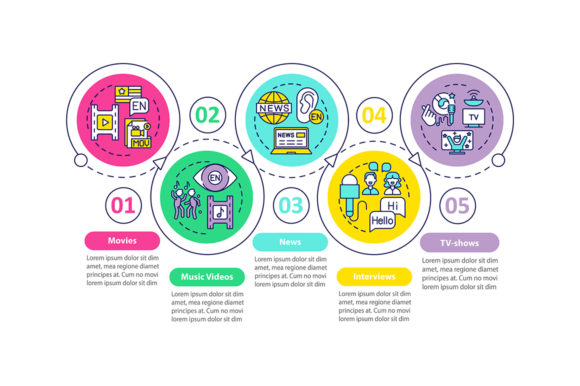
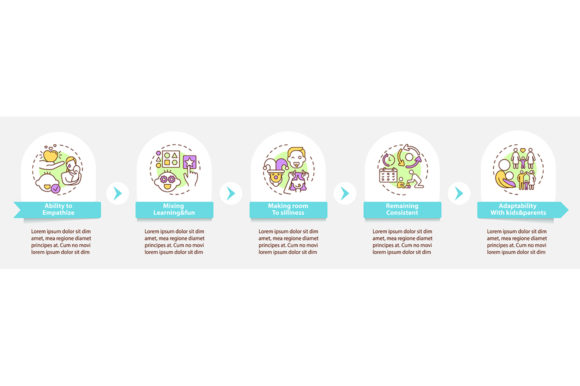
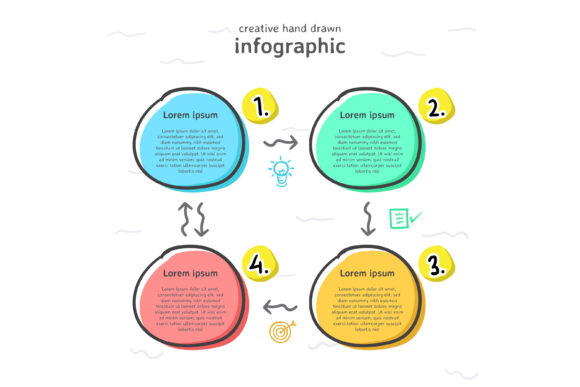
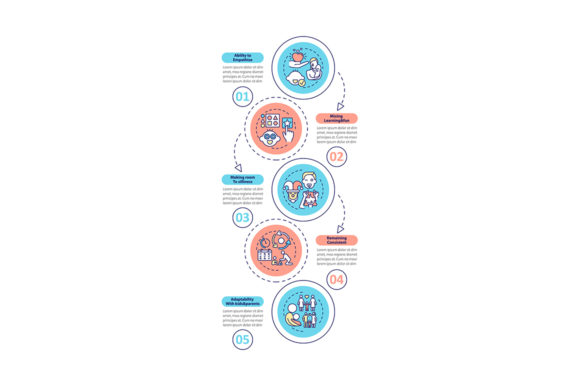
To effectively implement and explain educational games, it helps to adopt a structured approach. Utilizing a process timeline chart or a workflow layout with linear icons allows educators to break down complex methodologies into digestible steps. This data visualization technique is particularly useful in childcare presentation design elements, as it transforms abstract educational theory into a concrete action plan. Below is a recommended five-step workflow for integrating educational games effectively.
1. Assessment and Objective Setting
Before selecting any game, identify the specific developmental needs of the group. Are you targeting fine motor skills, language acquisition, or social cooperation? Use your infographic template to map out these goals visually. This step ensures that every chosen activity serves a purposeful role in the broader curriculum.
2. Curation and Adaptation
Select educational games for little kids that align with your assessed objectives. This stage involves evaluating materials for safety, inclusivity, and engagement levels. In your presentation, use linear icons to represent different types of games (e.g., a puzzle piece for cognitive tasks, a hand for tactile play). This visual categorization helps stakeholders quickly understand the variety and balance of your proposed activities.
3. Environmental Preparation
The physical or digital space must support the intended learning. This includes organizing materials, setting up stations, and ensuring accessibility. A workflow layout can illustrate the setup process, showing how traffic flow and material placement contribute to a successful session. Proper preparation minimizes transitions and maximizes active learning time.
4. Facilitation and Observation
During gameplay, the adult’s role shifts from instructor to facilitator. This step involves scaffolding learning, asking open-ended questions, and observing interactions. Data visualization is crucial here for documenting progress. Your template should include sections for noting observations, which can later be translated into reports or parent updates. This turns fleeting moments of play into actionable data.
5. Reflection and Iteration
After the activity, review what worked and what didn’t. Did the children engage as expected? Were the learning objectives met? Use the final segment of your process timeline chart to outline adjustments for future sessions. This cyclical approach demonstrates a commitment to continuous improvement, a key metric in high-quality childcare presentation design elements.
Leveraging Professional Design Assets
Creating these visualizations from scratch is rarely efficient. Accessing a comprehensive ZIP file containing EPS, JPG, PNG, SVG, and AI formats provides the flexibility needed for various applications. Vector files like EPS and AI are essential for print materials and large-format displays, allowing for infinite scaling without quality loss. Meanwhile, PNG and JPG formats are optimized for digital slides, newsletters, and web content. SVG files offer the best of both worlds for responsive web design and interactive documents.
When searching for an educational games for little kids vector infographic template, look for designs that feature soft colors, rounded shapes, and playful yet clean typography. These design choices resonate with the subject matter while remaining legible and professional. Linear icons are particularly effective because they reduce visual clutter, making complex workflows easier to follow. By using pre-designed childcare presentation design elements, educators can ensure consistency across all communications, reinforcing brand identity and trust.
Practical Applications and Outcomes
The application of these resources extends beyond simple aesthetics. When educators use structured data visualization to plan and present educational games for little kids, several positive outcomes emerge. First, clarity improves. Stakeholders can instantly grasp the logic behind curriculum choices, leading to greater buy-in and support. Second, efficiency increases. Having a reusable template means less time spent on formatting and more time spent on student interaction and lesson refinement.
Furthermore, these tools aid in professional development. New staff members can use workflow layouts to understand standard operating procedures and pedagogical expectations. Parents appreciate transparency; seeing a visual roadmap of their child’s learning journey builds confidence in the care provider. Ultimately, the combination of well-chosen educational games and professional presentation creates a holistic ecosystem where play is respected as serious work.
Tailoring Approaches for Different Users
Different audiences require different emphases when utilizing these resources. Classroom teachers might focus heavily on the assessment and facilitation steps of the timeline, using the template to track individual student progress over time. Childcare center directors, conversely, may prioritize the objective setting and reflection phases to demonstrate program efficacy to licensing boards or investors. Parents seeking home-based solutions can adapt the 5-step workflow to create consistent routines, using simpler versions of the infographic to explain rules and expectations to their children.
Regardless of the user, the core principle remains the same: structure enhances creativity. By leveraging high-quality assets like those found in a versatile ZIP file containing EPS, JPG, PNG, SVG, and AI formats, adults can elevate the discourse around early childhood education. Educational games for little kids deserve to be presented with the same rigor and professionalism as any other academic discipline. Through thoughtful design and strategic planning, we can ensure that play continues to be recognized as the vital foundation of lifelong learning.